
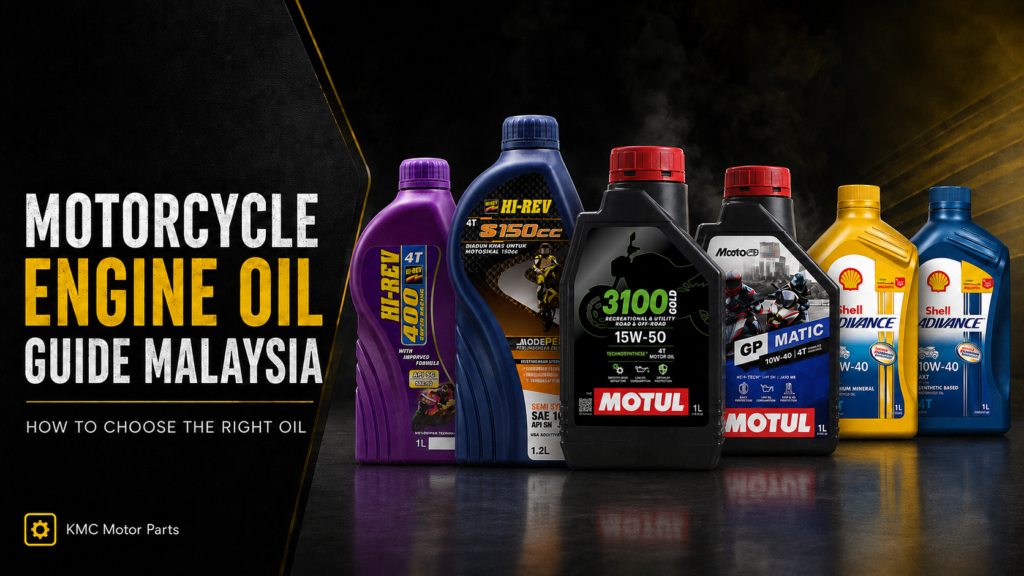
Quick Answer
Check your motorcycle owner’s manual before choosing engine oil. Make sure the oil has the correct viscosity, JASO rating and API rating for your motorcycle.
What Should You Check Before Buying Motorcycle Engine Oil?
Before buying engine oil, check the owner’s manual and the oil label. Do not choose by brand or price only. The oil must match your motorcycle’s required viscosity and specifications.
- Recommended viscosity, such as 10W-40 or 15W-50
- Required JASO rating, such as MA, MA2 or MB
- Required API rating
- Suitable oil type: mineral, semi-synthetic or fully synthetic
- Correct engine oil capacity
When the required specification is unclear, provide the motorcycle model, year and current oil details before purchasing.
Understanding Motorcycle Oil Viscosity
Motorcycle engine oil viscosity describes how easily the oil flows at different temperatures. A grade such as 10W-40 contains two numbers, and both are important when choosing the correct oil.
- The number before “W” shows how the oil flows during a cold start. A lower number generally means the oil flows more easily at lower temperatures.
- The number after “W” shows the oil’s viscosity when the engine reaches normal operating temperature.
- The viscosity grade does not show the overall quality of the oil or confirm that it is suitable for every motorcycle.
Common motorcycle oil grades include 5W-40, 10W-40, 10W-50, 15W-50 and 20W-40. These grades should not be treated as interchangeable. Even in Malaysia’s warm climate, a thicker oil is not always the correct choice. Follow the viscosity range recommended by the motorcycle manufacturer.
Mineral vs Semi-Synthetic vs Fully Synthetic Oil
Motorcycle engine oil is commonly available in mineral, semi-synthetic and fully synthetic types. These terms describe how the oil is made, but the correct choice still depends on the viscosity grade, JASO rating and API rating required by the motorcycle manufacturer.
| Oil Type | General Characteristics | Choosing Consideration |
| Mineral | A basic and generally more affordable type of engine oil. | Suitable when it meets the viscosity and specifications required for the motorcycle. |
| Semi-Synthetic | A combination of mineral and synthetic base oils, offering a balance between cost and performance. | Suitable for riders who want improved protection while keeping the cost reasonable. |
| Fully Synthetic | Made with more advanced synthetic base oils for better performance under higher temperatures and demanding riding conditions. | Choose it only when it is suitable for the motorcycle and meets the required specifications. |
The most expensive oil is not always the most suitable choice. A mineral or semi-synthetic oil with the correct viscosity and specifications may be more appropriate than a fully synthetic oil that does not meet the motorcycle manufacturer’s requirements.
What Do JASO MA, MA2 and MB Mean?
JASO is a standard used for four-stroke motorcycle engine oil. It helps riders identify whether an oil is suitable for the motorcycle’s clutch system, especially when the engine, clutch and transmission share the same oil.
| Classification | General Meaning |
| JASO MA | Suitable for motorcycles that require oil with wet-clutch friction performance. |
| JASO MA1 | A category within JASO MA with a lower friction range. |
| JASO MA2 | A category within JASO MA with a higher friction range, commonly required by many wet-clutch motorcycles. |
| JASO MB | A lower-friction oil commonly specified for certain scooters and motorcycles without the same wet-clutch requirements. |
JASO MA2 is not automatically the best choice for every motorcycle, and JASO MB is not suitable for every scooter. Always use the JASO rating recommended in the motorcycle owner’s manual.
Motorcycle Oil vs Scooter Oil
Motorcycle oil and scooter oil should not be chosen based only on the vehicle type. The correct oil depends on the engine design, clutch system, viscosity grade and JASO or API rating required by the manufacturer.
| Application | Key Consideration | What to Check |
| Wet-clutch motorcycle | The engine oil may also lubricate the clutch and transmission, so clutch friction performance is important. | Follow the specified viscosity and JASO MA or MA2 requirement. |
| Scooter without a wet clutch | Some scooters may use lower-friction JASO MB engine oil. | Confirm the exact viscosity and JASO MB specification in the owner’s manual. |
| Scooter or motorcycle with a different design | Oil requirements vary according to the engine and transmission design. | Check the motorcycle model, year and manufacturer specification before choosing. |
Do not assume that two oils are interchangeable simply because they have the same viscosity grade. For example, a 10W-40 JASO MA2 oil and a 10W-40 JASO MB oil may be made for different clutch systems and applications.
Common Motorcycle Engine Oil Mistakes
Choosing motorcycle engine oil based only on brand, price or viscosity can lead to an unsuitable purchase. The oil should match the motorcycle manufacturer’s required viscosity and performance specifications.
- Assuming thicker oil is always better for Malaysia’s hot climate.
- Checking the viscosity grade but ignoring the required JASO or API specification.
- Using JASO MB oil in a wet-clutch motorcycle that requires JASO MA or MA2.
- Assuming every scooter uses the same type of engine oil.
- Choosing fully synthetic oil without confirming that its specifications match the motorcycle.
- Using too much or too little engine oil instead of following the specified oil capacity.
- Extending the oil-change interval without considering the owner’s manual, riding conditions and engine condition.
When changing to a different brand or oil type, compare the viscosity grade, JASO classification and API service category on the product label. Brand names may differ, but the required specifications should still match the motorcycle manufacturer’s recommendation.
How Often Should Motorcycle Engine Oil Be Changed?
There is no single oil-change interval that is suitable for every motorcycle. The correct interval depends on the motorcycle manufacturer’s maintenance schedule, engine condition, oil specification and riding conditions.
- Follow the oil-change interval stated in the motorcycle owner’s manual.
- Change the oil according to time as well as mileage when the motorcycle is used infrequently.
- Frequent short trips, heavy traffic, high engine temperatures and demanding riding may require closer monitoring.
- Check the engine oil level regularly and investigate unusual oil loss instead of only topping it up repeatedly.
- Replace the oil filter or clean the oil strainer according to the motorcycle manufacturer’s maintenance schedule.
- Do not extend the service interval simply because fully synthetic oil is being used.
The safest approach is to record the service date and mileage after every oil change. When the maintenance history is unclear, consult a qualified workshop or refer to the motorcycle owner’s manual before deciding the next service interval.
Motorcycle Lubricants Available from KMC Motor Parts
KMC Motor Parts offers a range of motorcycle lubricants for different motorcycle models, engine requirements and riding needs. Our catalogue includes engine oils, scooter oils, gear oils and coolants from brands such as Castrol, Motul, Yamalube and Totachi, subject to current availability.
- Motorcycle 4T engine oils in different viscosity grades
- Scooter engine oils for suitable scooter applications
- Mineral, semi-synthetic and fully synthetic options
- Motorcycle gear oils and coolants
- Products with different JASO and API specifications
Before choosing a lubricant, compare the product specifications with the requirements stated in your motorcycle owner’s manual. Customers can browse our motorcycle lubricants catalogue and contact KMC Motor Parts to confirm suitability, stock availability and current price.
Frequently Asked Questions
Is 10W-40 suitable for every motorcycle?
No. Although 10W-40 is a common motorcycle engine oil grade, it is not suitable for every motorcycle. Check the viscosity range, JASO classification and API specification recommended in the motorcycle owner’s manual before choosing an oil.
What is the difference between JASO MA2 and MB?
JASO MA2 is designed for applications requiring higher wet-clutch friction performance, while JASO MB is a lower-friction classification commonly specified for certain scooters or motorcycles without the same wet-clutch requirements. Always follow the classification required for the specific motorcycle.
Can scooter oil be used in a manual motorcycle?
Only when the oil meets the viscosity and JASO or API specifications required by the manual motorcycle. Many scooter oils are classified as JASO MB and may not be suitable for a wet-clutch motorcycle that requires JASO MA or MA2.
Can I switch from mineral oil to fully synthetic oil?
In most cases, switching from mineral oil to fully synthetic oil is possible when the new oil has the correct viscosity and meets the JASO or API specifications required by the motorcycle manufacturer. Do not change oil type based only on price or marketing claims.
How do I know which engine oil suits my motorcycle?
Check the motorcycle owner’s manual for the recommended viscosity grade, JASO classification, API service category and oil capacity. When the information is unclear, provide the motorcycle model, year and current oil specification to KMC Motor Parts before purchasing.
How often should motorcycle engine oil be changed?
Follow the service interval stated in the motorcycle owner’s manual. The appropriate interval can vary according to the motorcycle, oil specification, mileage, time and riding conditions. Fully synthetic oil still requires regular replacement and should not be used as a reason to ignore the manufacturer’s maintenance schedule.
Need Help Choosing Motorcycle Lubricants?
Not sure which engine oil, scooter oil, gear oil or coolant is suitable for your motorcycle? Send KMC Motor Parts your motorcycle model, year, required specification and preferred product. We can help you check suitable options, current stock and price.